
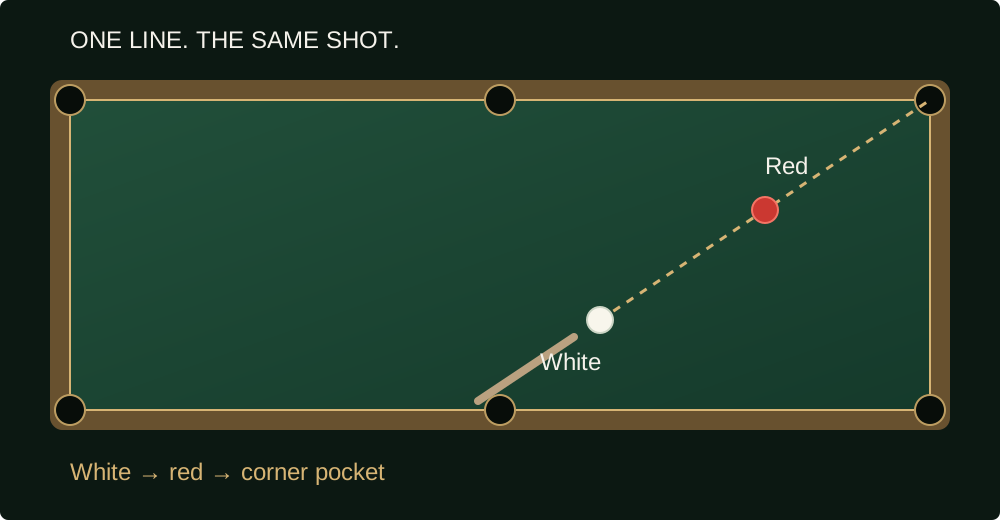
Set up a short, comfortable shot.
During a practice session, place one red a short distance from a corner pocket. Put the white behind it so the pocket, red and white form one straight line. Keep both balls away from cushions and leave enough room for a comfortable bridge.
Avoid stretching. Reset both balls between attempts. This is a practice layout, not a frame’s starting arrangement. Ask the club before rearranging balls on a booked table.
Use the same preparation for ten attempts.
Keep the task simple: avoid deliberate side spin, keep the cue as level as the shot allows, and use a comfortable pace.
- Stand behind the shot and check the straight line before lowering onto it.
- Settle into a balanced position and make a steady bridge for the cue.
- Check that the tip is aimed near the centre of the white, with no intentional side spin.
- Prepare calmly, then deliver along your intended line. Keep your head and body quiet through the shot.
- Let the balls stop. Record the result, reset the layout and repeat until you have made ten attempts.
Reference: WPBSA Blueprint: The Basics · 147 Academy: The Stance
Record observations, not just pots.
Write down how many reds you potted out of ten. Beside each miss, note whether it went left or right, whether you stood up early, and whether the white entered a pocket. “Six out of ten; most misses left” gives you a clearer question than “I played badly.”
A miss direction does not diagnose the cause. Setup, alignment and delivery can all contribute. Choose one simple observation for the next set, such as keeping the bridge steady; avoid changing your grip, stance and pace together.
Reference: 147 Academy: Practice Routines — Learning
Make the next set useful.
If the layout is too difficult, shorten the distance. If it is comfortable, repeat it before moving the white farther away. Change only the distance, so you can compare like with like.
Keep a small record of the layout, date, pots and chosen focus. Results will vary; one good set does not prove the problem is solved. The value is having a repeatable exercise and something concrete to discuss at coaching.
Reference: 147 Academy: Practice Routines — Learning
A few quick questions.
Must I pot all ten before moving on?
No. Ten attempts make an easy record, not an official pass mark. Adjust the difficulty to your level and ask your coach what progression suits you.
What if the white also goes into the pocket?
Record it separately. Potting the white is a foul in a frame. During this routine, its path is an observation to discuss; this exercise does not promise a stop shot or a particular cue-ball position.
Does a good result mean I can build large breaks?
No. A repeatable straight pot is one part of the game. Break-building also involves shot selection, positional control and dealing with different layouts.